
Kitchen Helper
A good kitchen knife can make up to half of the work easier and faster. We've all probably seen some cooking show on TV and thought that preparing a dish doesn't really go that smoothly in real life. Especially when we watch a chef chop an onion in 5…
A good kitchen knife can make up to half of the work easier and faster.
We've all probably seen some cooking show on TV and thought that preparing a dish doesn't really go that smoothly in real life. Especially when we watch a chef chop an onion in 5 seconds. Yet the main obstacle to that culinary elegance may not be the (lack of) skill of our hand, but the quality of the knife.
Don't skimp on the knife
Choosing the ideal knife is a fairly individual matter, but there are a few features that a quality knife should have. Then you can more easily imagine how it will cut for you.
Type of knife
They say that every home cook should have a knife for meat, vegetables, bread, boning, and maybe a few others. The truth is that unless we're a pro, we primarily use one, at most two knives in the kitchen. And when we have one universal helper, it should be a quality and versatile one.
Like a glove
The knife should fit well in your hand, have a blade 15-18 centimeters long and at least 3 millimeters wide. When you cut with the knife, it's good to feel that you have a sturdy tool in your hand. So it should also weigh something.
It can't be said that 'the more expensive, the better' always applies, but in this case price does reflect quality. You can buy a knife for two hundred crowns, but at that price, knives that last long cannot be made. The price of a quality knife for home cooking is around 800-1000 CZK.
Material
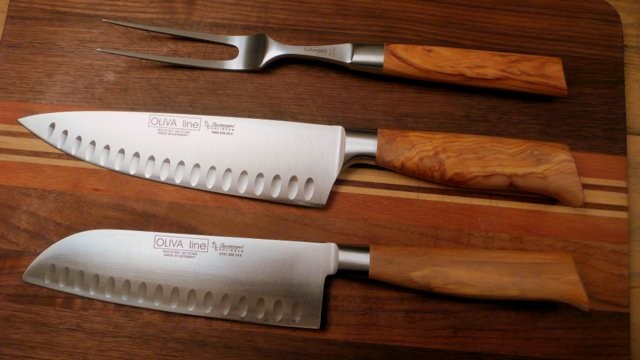
We can choose from various materials. If you're into healthy eating and don't want to lose nutrients from fruits or vegetables, a ceramic knife will be a pleasant option. Cutting with a ceramic knife doesn't cause a reaction that destroys nutrients. With a steel knife, a chemical reaction does occur, but if we look at the overall quality, it's not such a big deal. On our e-shop, you can choose knives made of genuine Solingen steel for both home and professional use. We also offer luxury knives with olive wood handles.
Ceramic knives are also more prone to damage - they are not suitable for the dishwasher. Steel knives should survive the dishwasher without harm if they have a plastic handle. But if you have a really expensive and quality knife, give it a little extra time and rather wash it under running water.
The lifespan of your knife is also affected by the surface you cut on. The most suitable for home use is a wooden cutting board, which has a natural antiseptic effect. Glass boards are nice to look at, but they will constantly dull your knife.
Carbon or stainless?
Nowadays, stainless steel is the most used - everyone knows this steel, so they're not afraid to work with it. You can easily sharpen it at home with a classic sharpening steel. It's resistant to damage, but some might add that corrosion is not entirely foreign to it. If you leave water on it, spots may appear. Even after careful sharpening, stainless steel never reaches the sharpness of carbon steel.
Carbon steel is not as common even though it's sharper than stainless. The edge dulls, tarnishes, and rusts faster. After contact with water, you must always dry the knife, and not everyone has time for that while cooking.
For comfortable cutting
- The handle can be raised to protect your hand and make you feel confident working with the knife.
- If the blade is curved, "rocking" motions that speed up cutting will be easier.
- Always cut on a sufficiently large board - it should be larger than the knife.